CULTURE · 2026-09-24
Songpyeon vs Mochi: Same Sticky Rice, Different Holiday
By Dduk Curator
Chuseok half-moons versus Japanese mochi — dough, filling, steam versus pound, and when the words get borrowed on a cafe menu.
TL;DR
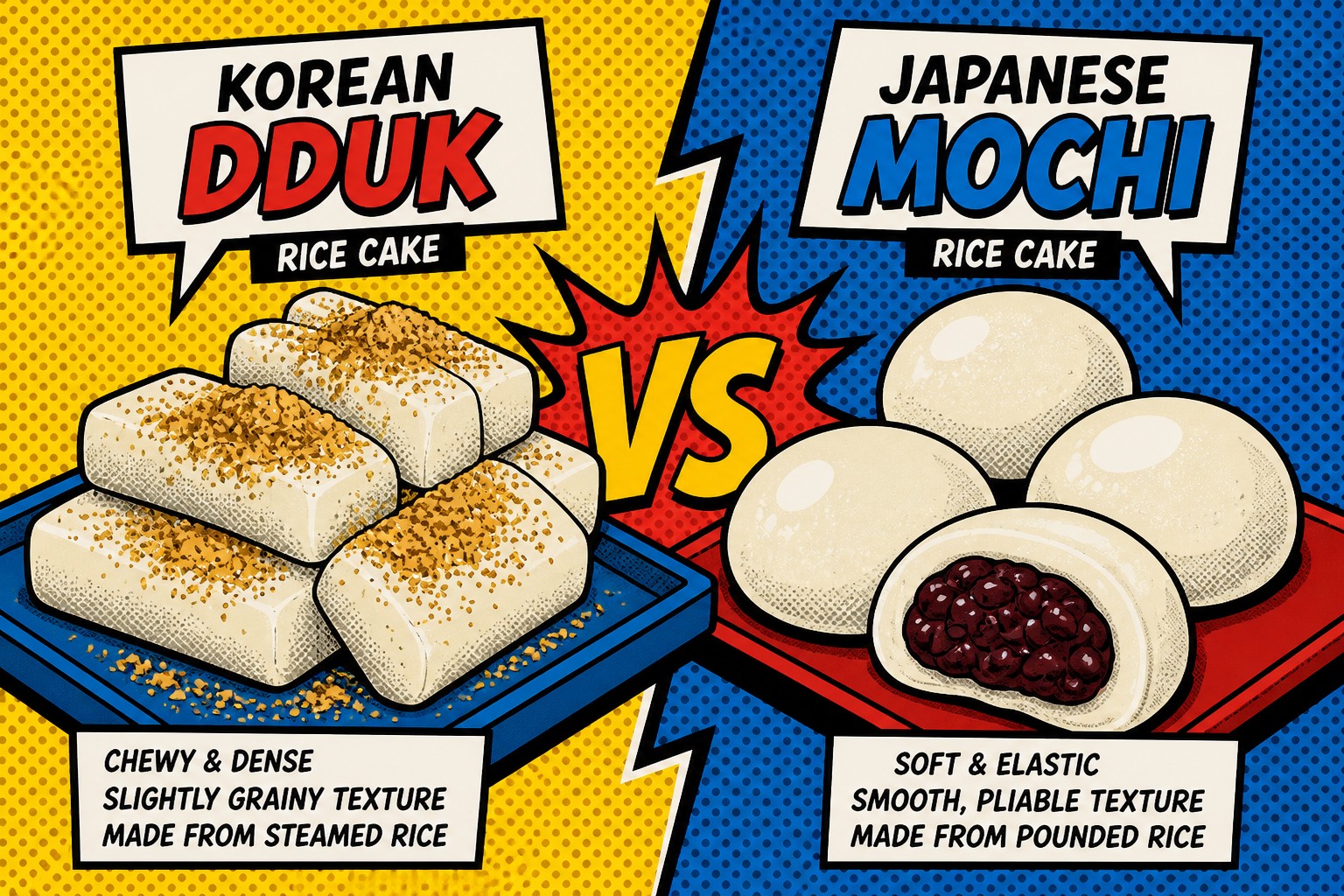
Songpyeon is a Korean Chuseok rice cake: a thin, often non-glutinous-leaning dough folded around sesame or bean, steamed on pine. Mochi is a Japanese pounded glutinous-rice cake, often wetter and stretchier, sometimes wrapped around anko or ice cream. Related, not interchangeable. Do not call a pine-scented half-moon “mochi” on a label if you can help it.
Searches for “songpyeon vs mochi” land on this site because we already sit in the dduk-versus-mochi cluster: /blog/what-makes-dduk-distinct-mochi-comparison/ and /blog/science-and-art-of-rice-cakes-glutinous-vs-nonglutinous/. Those pages are the physics. This page is the holiday objects — the half-moon you pinch at Chuseok and the pounded cake that shows up at Japanese New Year and in grocery-freezer daifuku.
Songpyeon is a filled pocket. You press a small ball of dough into a cup, add a teaspoon of filling (sweetened sesame, chunky bean, or honeyed soybean), pinch it into a half-moon, and steam it, traditionally over pine needles. The skin should go slightly translucent. The smell in the kitchen is pine and rice, not toasted soybean powder. A heritage method is /recipes/songpyeon-pine-heritage/. Everyday tteok-shop notes also live on https://tteok.ai/blog/songpyeon-and-seollal-baekseolgi-rituals/.
Mochi, in the sense English speakers usually mean, is glutinous rice steamed and pounded while hot until it stretches. It can be eaten plain, dusted with kinako, pulled into kagami rounds, or stretched thin around anko as daifuku. The moisture is higher; the pull is longer; the skin is not a pinched seam. Cafe “mochi” that is a freezer ice-cream ball is a descendant of that technique, not of songpyeon.
Dough chemistry is why they are not swap-in skins. Songpyeon dough is often a blend that includes non-glutinous rice flour so the moon holds a shape and a clean pinch. Too much glutinous flour and the seam smears; too little and the skin cracks in the steamer. Mochi dough wants nearly all glutinous rice (mochigome / chapssal) so the network stretches instead of snapping. The science post on this site is the longer starch explainer. Use it if a batch failed and you need a ratio reason.
Fillings tell on the tradition. Songpyeon fillings are usually dry-ish so they do not burst the pinch: sesame, bean, sometimes honey. Mochi fillings (when present) can be wetter — red bean paste, fruit, ice cream — because the skin is a stretch wrap, not a dumpling crimp. If your “songpyeon” is stuffed with ice cream, you made a fusion dessert. Fine to eat. Label it honestly.
Heat and finish. Songpyeon is steamed, then sometimes brushed with sesame oil so the moons do not stick. Mochi is pounded (or machine-extruded) and eaten soon, or dusted so the surface does not glue to itself. Reheating is different: songpyeon re-steams as a shaped cake; leftover mochi is often toasted or simmered in soup (ozoni), which is closer to how Koreans treat garae in tteokguk than to a Chuseok platter.
Calendar, not branding. Songpyeon is tied to Chuseok, the Korean harvest holiday, and to the idea of families shaping moons together. Mochi calendars include Japanese New Year pounding and a long Buddhist and court history that is not ours to flatten into a sentence. This site will not invent a proverb or a “who invented sticky rice” score. Rice traveled. Rituals localized.
Cafe menus blur the words because “mochi” is the English shoppers already know. A pastel injeolmi cube may get called mochi. A songpyeon may get called a “Korean mochi dumpling.” For SEO we answer the comparison; for cooking we keep the names. If you are ordering catering, ask whether the cake is pinched and steamed or pounded and stretched. The mouthfeel will tell you if the kitchen understood the question.
Related Korean cakes people mix into this search. Injeolmi is pounded glutinous rice rolled in roasted soybean powder — closer to mochi physically, still Korean in coating and occasion: /recipes/injeolmi-traditional-pound/. Garae-tteok is a cylinder for soup or tteokbokki, not a dessert moon. Spicy braised cakes belong on the hub at https://tteokbokki.ai/, not on a Chuseok plate. Storage and re-steam for leftover dduk: /blog/storage-freezing-and-re-steaming-dduk/.
A home test if you are curious, not a contest. Make or buy one songpyeon and one plain mochi piece. Bite. Songpyeon should show a seam and a distinct filling; the skin is tender but not a long pull. Mochi should stretch and then slowly retract. If both stretch like gum, your songpyeon dough was too glutinous or under-steamed into glue. If both snap dry, both sat out too long — rice cakes stale fast.
We will not quote a celebrity preference we cannot source, and we will not pretend one cake is healthier. Both are rice. Both are holiday food. The useful distinction is technique and table: pine steamer versus pounder, pinch versus stretch, Chuseok platter versus daifuku box.
If you need a savory rice-cake next, leave this cluster and go to https://tteokbokki.ai/blog/wheat-vs-rice-tteok-for-tteokbokki/ or https://tteok.ai/blog/frozen-vs-fresh-tteok-storage/. If you need the wide Asia cousins (nian gao, tikoy), /blog/history-of-mochi-variations-across-asia/ already exists. This page stays on the two words in the query.
Color on songpyeon is usually a small amount of mugwort, gardenia, or cockscomb in the dough — pale green, yellow, pink — not food-color theater. The moons should still look like rice. If a cafe songpyeon is neon, that is a pastry kitchen talking. Fine to eat. It is not a Chuseok teaching plate. Mochi color is often the filling or a dusting (matcha, kinako), not a pinched seam dyed through.
Store-bought vs homemade, honestly. Grocery songpyeon is often denser and less pine-scented than a home steamer. Grocery mochi (especially ice-cream daifuku) is a freezer dessert with a thin skin, not a New Year pounding. Comparing those two packages teaches you less than comparing one homemade or bakery songpyeon with one plain freshly made mochi piece. If you only have packages, still look at the seam versus the stretch. The structure is the lesson.
Language on a menu. “Korean mochi” as a heading is a translation shortcut. Ask whether the cake is songpyeon, injeolmi, or something else. Injeolmi is the Korean cake that physically resembles pounded mochi; songpyeon does not. If a shop refuses to use either Korean or Japanese name and only says “rice cake dumpling,” look at the shape. Half-moon with a pinch is songpyeon logic. Smooth round wrap is daifuku logic. A cube in soybean powder is injeolmi logic. Three cakes. Three pages. This one is the first two words people type.
More Korean food
Relevant pages on the two hub sites — recipes and a BBQ directory on bulgogi.ai, street rice cakes on tteokbokki.ai.
- bulgogi.ai — recipes & BBQ directory →Marinades, cuts, and a USA Korean BBQ map.
- tteokbokki.ai — street rice cakes →School-cart sauce, rose, mala, and tteok types.
- Everyday tteok shop staples →Garae and tteokguk slices you buy weekly, not for a wedding tower.